Two months live, zero customers: an honest autopsy of my inventory SaaS
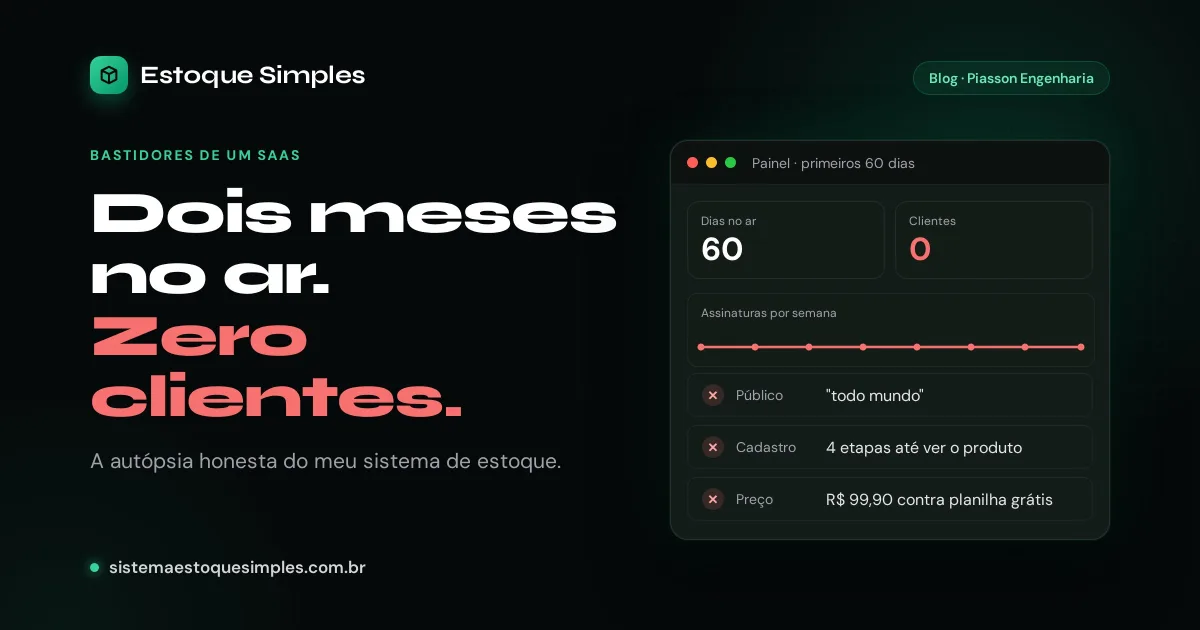
The product was ready. The customers never showed up.
Two months ago I launched Estoque Simples, an online inventory control system built for the Brazilian market. The idea fit in one sentence: build a simple inventory system and sell it cheap.
Technically, it was a solid product: multi-tenant, hundreds of automated tests, two-factor login, PDF and Excel reports, recurring billing built in.
The result after sixty days: zero customers.
Not "a few". Zero.
When that happens, a developer's instinct is to open the editor and build one more feature. I did the opposite: I stopped and reviewed the whole product coldly, as if it belonged to someone else. The diagnosis had four parts, and none of them was code.
1. "For everyone" means for no one
My landing page said, in short, "simple inventory control for small businesses". It sounds reasonable. The problem is that the same sentence describes dozens of systems, many of them with years on the market, invoicing, marketplace integrations and a sales team.
Anyone who sells products needs invoices, a point of sale, integrations. I had none of that and would not have it any time soon. I was competing for the most crowded search in the segment with the least complete product.
But there is an inventory nobody sells: the internal stockroom. The gloves in a clinic, the cleaning supplies in a condominium, the toner in an office, the paper in a school. That material has no sales invoice, no customer, no selling price. It has one question only: who took it, how much, and when will it run out.
An ERP is overkill for that, and a spreadsheet can no longer keep up. It was exactly the size of my product.
2. The front door had four locks
My signup was a multi-step wizard asking for the company tax ID (CNPJ), a company e-mail and a phone number. Then came e-mail confirmation. Then mandatory two-factor authentication setup.
From a security standpoint, flawless. From the standpoint of someone who just wants to see whether the system fits, those were four reasons to close the tab before seeing a single screen of the product.
And there was a worse detail: the clinic's receptionist, the building caretaker, the school coordinator, the people who actually look after the stockroom, rarely know the company tax ID by heart.
3. The price said "cheap" and charged like a mid-market tool
There were three plans: R$ 49.90, R$ 99.90 and R$ 199.90 per month. After a 14-day trial, the account was locked.
For someone using a spreadsheet that costs nothing, R$ 99.90 a month is not cheap. And locking the account at the end of the trial meant that every signup that did not turn into a payment turned into a person lost for good.
4. There was no path from the spreadsheet to the system
People who track inventory already have the data somewhere, almost always in a spreadsheet. My system welcomed them with an empty screen and a "New product" button.
Typing in two hundred items, one by one, is not a welcome. It is a punishment.
What I did not do: rewrite
The most important part of the diagnosis was what it ruled out. The code was fine. It did not need a new framework or a fresh start. It needed four product decisions:
- Niche. Internal stockrooms, with dedicated pages for clinics, condominiums, offices, schools, repair shops, NGOs, construction sites and hotels.
- Entry. One-screen signup: name, e-mail and password.
- Offer. A forever-free plan and a single paid plan at R$ 39.90 per month.
- Migration. Spreadsheet import and sample data on first access.
Throughout this week I will detail each of these changes here on the blog: the reasoning, what broke along the way and what I would do differently.
The lesson that applies to any product
I spent two months thinking I was missing features. I was missing someone specific on the other side.
A product without customers is rarely an engineering problem. And that is exactly why engineers take so long to notice.
I do not know yet whether the repositioning will work, and I will not pretend I do. What changed is that it can now be measured. The new version is live at sistemaestoquesimples.com.br, with a real free plan.
If you look after a stockroom, or know someone who does, try it and tell me where you got stuck. That is the most valuable feedback I can get right now.
Related posts
Your inventory spreadsheet is lying to you: 7 signs it is already costing you money
An inventory spreadsheet does not break all at once: it drifts quietly, and the bill shows...
I asked for a tax ID, e-mail confirmation and 2FA before showing the product. Nobody stayed
My signup had four steps before the first useful screen, and the confirmation e-mail I req...
Sistema de Estoque Simples: how small businesses trade the spreadsheet for real control
Spreadsheets break silently, and traditional ERPs are too expensive and complex for busine...