Your inventory spreadsheet is lying to you: 7 signs it is already costing you money
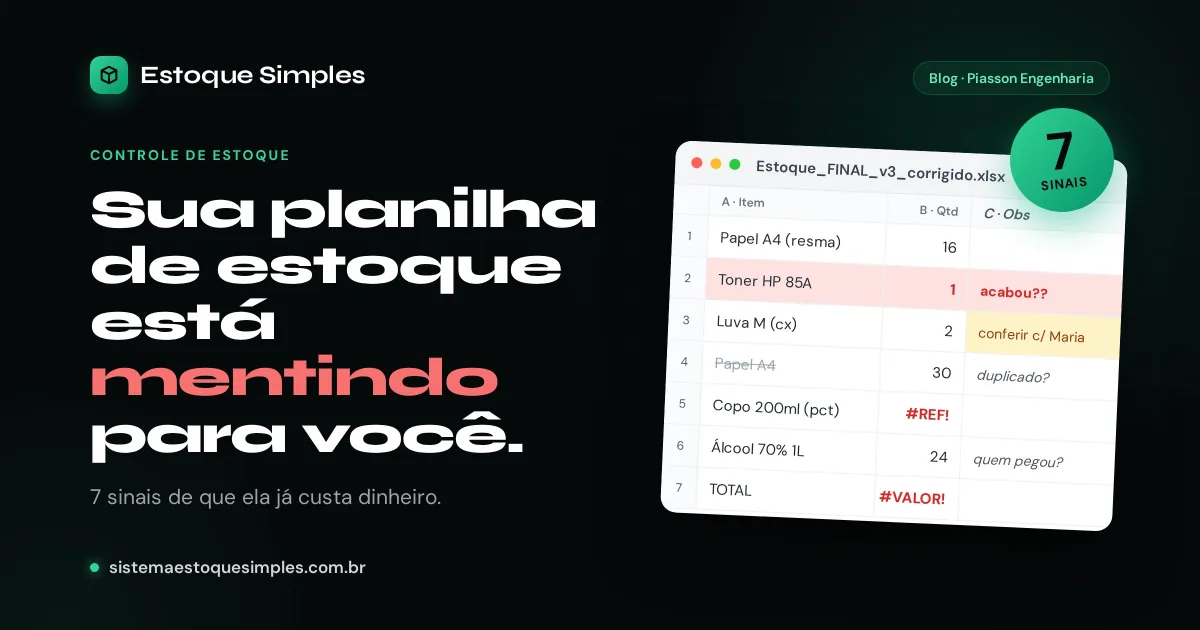
A spreadsheet does not fail all at once
Nobody decides to track inventory badly. The spreadsheet starts out great: one tab, twenty items, one person in charge.
The problem is that it fails gradually, in silence. And the loss shows up in places nobody links back to it: the emergency purchase, the rescheduled appointment, the supplies that "went missing".
Seven signs that this is already happening to you.
1. The spreadsheet and the shelf never match
If every count ends with someone fixing the quantity by hand, the spreadsheet has stopped being a control and become a guess. And a guess is no basis for a purchase decision.
2. There is a file called "inventory_FINAL_v3_fixed"
When there is more than one file, there is more than one truth. It takes one person updating the wrong copy for every balance to become suspect.
3. Only one person knows how to use it
They go on vacation and the control stops. They leave the company and the history leaves with them. A process that depends on one person's memory is not a process.
4. You find out it ran out when someone goes to get it
A spreadsheet does not warn anyone. Someone has to open it, scan line by line and compare against a minimum that is probably not even written down. In practice, the low-stock alert is the empty shelf.
5. Nobody knows where the material went
The spreadsheet records how much there is. It rarely records who took it, for which department and when. Without that, you cannot answer the question that matters most: did consumption go up, or is material disappearing?
6. Purchases are made by eye
Without consumption history, every purchase is an estimate. The outcome is the two classic losses: money tied up in the item that is left over, and the rushed, more expensive purchase of the item that is missing.
7. A broken formula went unnoticed for months
A #REF!, a row inserted outside the sum range, a number typed over a formula. A spreadsheet has no guard rails: any wrong click changes the balance and leaves no trace.
Why this weighs more on internal-use inventory
Those who sell products notice the error fast, because the cash register gives it away.
In an internal stockroom it is different. The gloves in a clinic, the cleaning supplies in a condominium, the paper in a school, the parts in a repair shop: there is no sale to expose the difference. Material disappears slowly and the cost dissolves into the month.
The inventory with the least natural control tends to live in the most fragile tool.
What minimal control needs
It does not have to be an ERP. It needs four things:
- A single balance, updated by stock entries and withdrawals, not by typing over a number.
- A record of who took what and for which department.
- A minimum stock level per item, with a list of what is running low.
- A history that cannot be erased and can be consulted later.
That is the scenario I repositioned Estoque Simples for: stockroom control for those who do not sell what they stock. The product is in Portuguese and built for the Brazilian market.
There is a page with examples for each kind of operation: clinics and practices, condominiums, offices, schools and churches, repair shops, NGOs, construction sites and hotels and inns.
What about the spreadsheet you already have?
It does not go in the trash: it becomes the starting point. The system has an import template. You paste your items, upload the file, and the whole catalog goes in at once.
The free plan is forever and covers up to 10 products, enough to start with the items that cause the most trouble. Every account starts with 14 days of the Pro plan unlocked, no card required.
If you recognized three or more signs on the list, the test is worth ten minutes: create your free account.
Related posts
I asked for a tax ID, e-mail confirmation and 2FA before showing the product. Nobody stayed
My signup had four steps before the first useful screen, and the confirmation e-mail I req...
Two months live, zero customers: an honest autopsy of my inventory SaaS
I launched a cheap, well-tested, secure inventory system. Two months later, not a single c...
Why technology matters: it became infrastructure, not a differentiator
There was a time when using technology was a differentiator. That time is over. Today tech...