I cut the price by 60% and added a forever-free plan. The math behind the decision
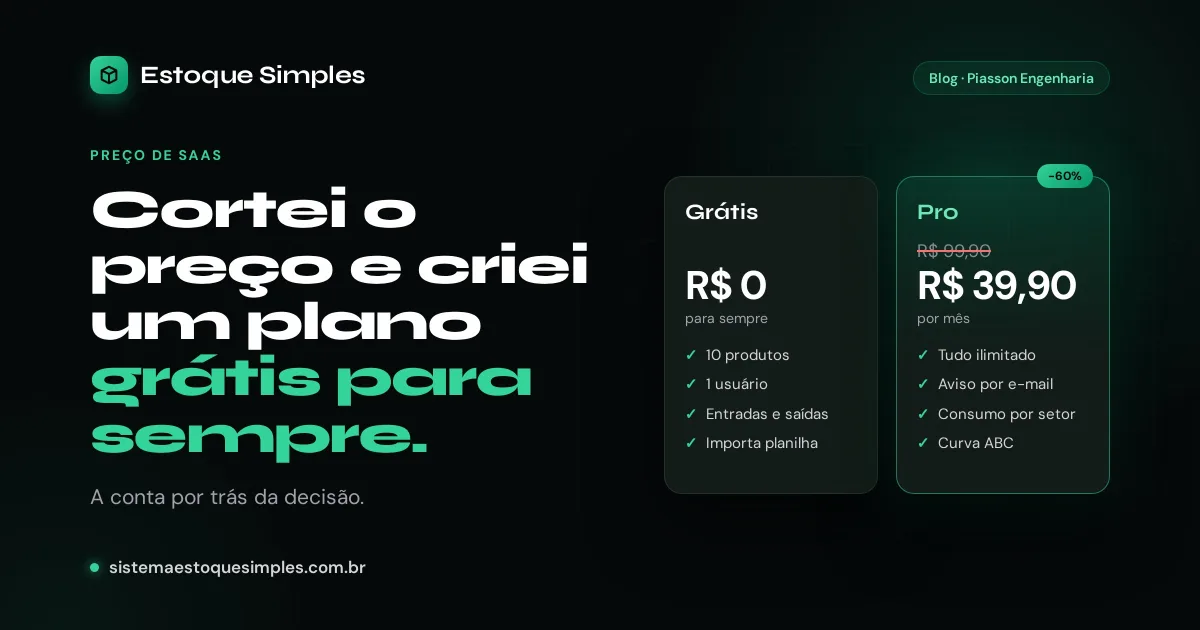
Three plans, zero subscribers
The first pricing table of Estoque Simples, my stockroom control SaaS for the Brazilian market, looked like every SaaS pricing table: Starter at R$ 49.90, Pro at R$ 99.90 with a "most popular" badge, and Business at R$ 199.90. A 14-day trial; after that, the account was locked until payment.
"Most popular" among zero subscribers.
The table copied the format of mature products without having any of the reasons that make that format work. Two months after launch, I redid all of it: a forever-free plan and a single paid plan at R$ 39.90. This is the math behind the decision.
Problem 1: the competitor costs nothing
I compared my price with other systems. My customer compared it with the spreadsheet, which is free and already open on their computer.
Against a competitor that costs zero, the debate is not "R$ 99 or R$ 49". It is whether the person will take out a card to solve a problem they still find tolerable.
For the stockroom of a clinic or a condominium, R$ 99.90 a month needs someone's approval. R$ 39.90 fits within the decision of whoever has the problem in their hands.
Problem 2: three plans demand a decision the customer cannot make
Starter, Pro or Business? To choose, people had to predict how many products and users they would have, before having used the system. Every row of the comparison table was one more doubt.
Today there are two states: Free and Pro. Pro is unlimited in products and users and costs R$ 39.90 per month, or R$ 399.00 on the yearly plan, which equals two months free. There is nothing to calculate.
Problem 3: a trial that locks throws the signup away
In the old model, the trial ended and the account froze. Anyone who did not pay within 14 days lost access, and I lost the person, along with all the effort it took to bring them there.
Inventory is not a problem you solve in two weeks. People add their items, get run over by their routine and come back a month later. In the locking model, they come back to a closed door.
The change: the Free plan became the permanent floor. Every account starts with 14 days of Pro unlocked, no card required. When that period ends, or when a subscription is cancelled, the account drops to Free. Nothing is deleted, nothing is locked.
How much to give away: the hard part
I got this wrong twice before settling. The first version of the free plan allowed 50 products. Then I lowered it to 20. I settled on 10 products and 1 user.
A free plan has to be truly useful to someone, and small enough that natural growth leads to the paid plan.
- With 50 items, a small practice or an entire office fits in the free plan forever. I would be handing the full product to precisely my ideal customer.
- With 10, you can control the critical items, the ones that always run out, and feel the value. Anyone who wants the whole stockroom needs Pro.
Where the line between free and paid runs
What stayed Pro-only follows a single logic.
Free controls: stock entries, withdrawals, withdrawals by department and requester, spreadsheet import, PDF and Excel reports, a low-stock list on the dashboard.
Pro works on its own: a daily e-mail of what is running low, consumption by department with a restocking forecast, and ABC analysis.
The boundary is not "works or does not work". It is "you check the system" versus "the system tells you".
What about the cost of carrying free accounts?
It is the classic objection, and the answer depends on the product. An account with 10 products and 1 user takes up a few database rows. The marginal cost is close to zero.
The real cost of a free plan is not servers. It is support, and the temptation to shape the product around people who will never pay. That is why the limit is low and the rule is simple.
What I still do not know
I will not make up a happy ending: the change is recent and I have no data yet to say it worked.
What changed is that the funnel can now be measured in stages: visit, signup, usage, limit, subscription. Before, it ended in a locked account on day 15.
If you are pricing a small SaaS, these are the three questions I should have asked on day one:
- What does the customer really compare my price to?
- Who has to approve that amount?
- What happens to those who do not pay when the trial ends?
The full table of what changes from Free to Pro is on the Estoque Simples home page.
Related posts
Your inventory spreadsheet is lying to you: 7 signs it is already costing you money
An inventory spreadsheet does not break all at once: it drifts quietly, and the bill shows...
I asked for a tax ID, e-mail confirmation and 2FA before showing the product. Nobody stayed
My signup had four steps before the first useful screen, and the confirmation e-mail I req...
Two months live, zero customers: an honest autopsy of my inventory SaaS
I launched a cheap, well-tested, secure inventory system. Two months later, not a single c...